A real-time lead portal a whole team works at once.
A sales team was working a shared lead list out of a spreadsheet while several people called at once.
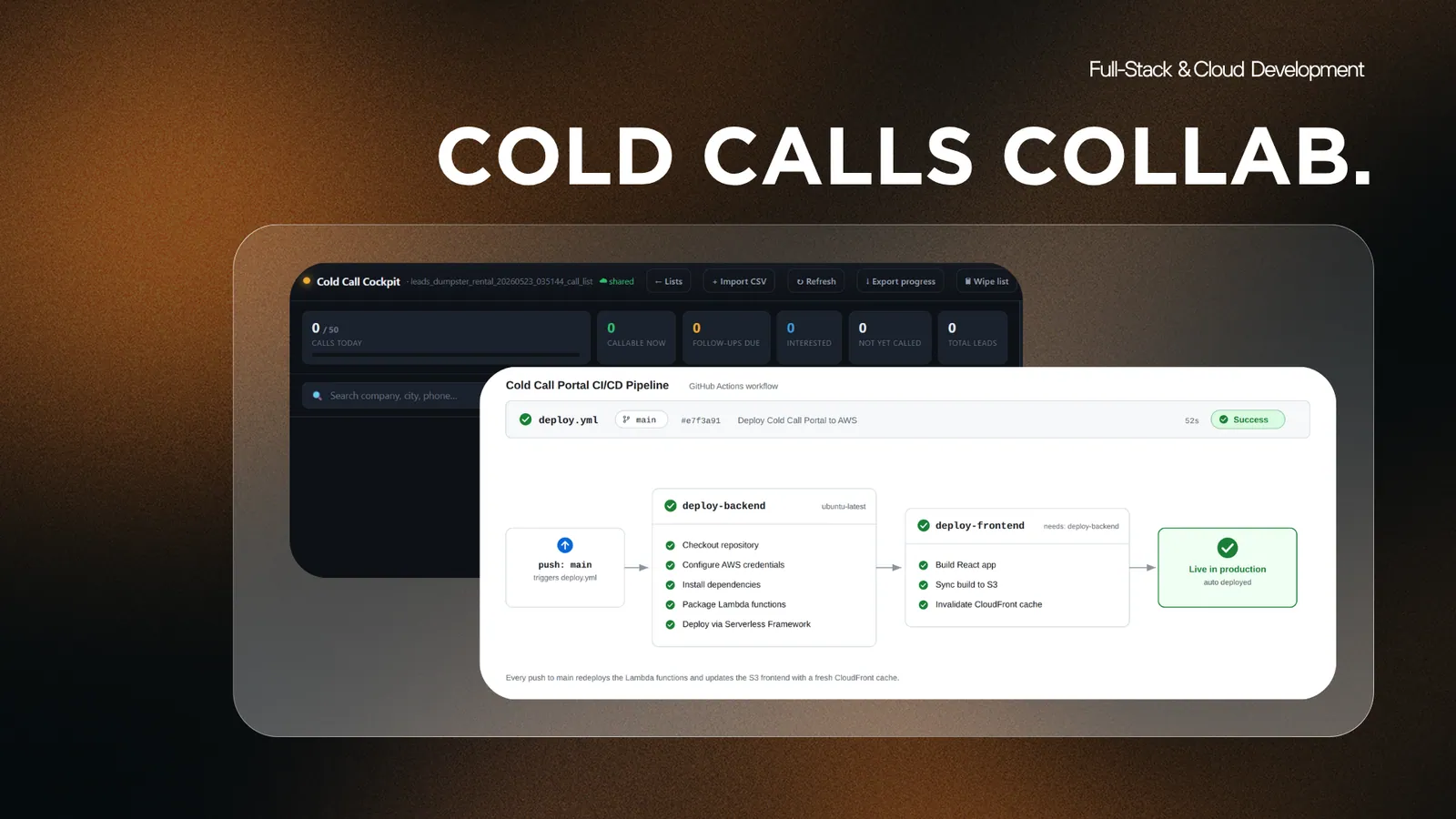
A shared, real-time cold calling workspace where every note, status update, and flag syncs instantly across all connected users.
Cold Call Collaboration Portal
A sales team was working a shared lead list out of a spreadsheet while several people called at once. Two reps would ring the same number because one of them had not saved yet. We replaced it with a real-time portal where the list is one live thing: when somebody adds a note, marks a lead done or flags it, everyone else sees it immediately without refreshing. Private and shared lists sit alongside each other, so a rep can work their own follow-ups without leaving the team view. It runs fully serverless on AWS, with a DynamoDB stream pushing every change out over a WebSocket, which is what makes the live view cheap to run rather than a server somebody has to watch.
Portal Dashboard
Multiple users can log in and work from the same shared list of leads. When one person adds a note, marks a lead done, or flags it, every other connected user sees the update instantly, no refresh needed. Each user can also create private lists visible only to them, or public lists shared among the rest of the team.
CI/CD Pipeline
The deployment pipeline runs as a GitHub Actions workflow. A push to main triggers deploy-backend, which packages and deploys the Lambda functions through the Serverless Framework, then deploy-frontend builds the React app, syncs it to S3, and invalidates the CloudFront cache. Every push ships to production automatically, with no manual deploy steps.
Cloud Architecture
The AWS architecture is fully serverless. Route 53 routes frontend traffic to CloudFront and S3, where the React app is hosted, and API traffic to API Gateway, which invokes Lambda functions that read and write leads in DynamoDB. A DynamoDB Stream triggers a Lambda that broadcasts every change over a WebSocket connection, so all logged-in users see updates live, with no servers to manage.
Built, shipped, and running.
Running something like this on a spreadsheet?
Tell us what it has to do and when it needs to be live. You’ll get back the architecture we’d use, the trade-offs, and a realistic timeline.